

Boston-based Zeta Surgical is establishing its European engineering and R&D hub in the Greater Zurich Area as it advances the next generation of AI-powered surgical navigation and robotics for image-guided neurosurgery. Drawn by the region's interdisciplinary engineering talent, leading universities, research hospitals and collaborative innovation environment, the company plans to build core engineering capabilities, clinical research collaborations and the foundations for European commercialization from Greater Zurich.
We spoke with José Amich, Co-Founder & CEO of Zeta Surgical, about making advanced surgical navigation more accessible, building the company's European engineering hub, and why Greater Zurich became a natural choice for its next phase of growth.
From Boston to Greater Zurich: Making AI-powered surgical navigation more accessible
Developing breakthrough medical technologies requires more than scientific excellence. As companies grow, they need access to interdisciplinary engineering talent, clinical expertise and research partners that can accelerate innovation. Greater Zurich has become one of Europe's leading locations where AI, robotics, medical imaging and life sciences converge – helping international companies build the next generation of healthcare technologies.

Tell us a bit about Zeta Surgical. What problem were you solving?
Zeta Surgical is a Boston-born medtech company that builds AI-powered navigation and robotics for image-guided neurosurgery and targeted neurotherapeutics. The original obsession was very simple: we wanted to make the precision of advanced image guidance available wherever the patient and physician need it, not only in the most complex operating-room setups.
In brain procedures, a few millimeters can matter enormously. Yet precise navigation is practically only available in scarce, expensive operating rooms. Our goal has been to make navigation faster, easier to deploy, and precise enough for emergency clinical workflows and other non-OR settings – from external ventricular drain placement and biopsy to shunt procedures, rhizotomy, and targeted Transcranial magnetic stimulation (TMS).
What continues to motivate us is the idea that technology should reduce the gap between what is possible in an ideal surgical environment and what is available at the point of care.
Scaling the next generation of medtech
As AI, robotics and medical imaging continue to converge, successful medtech innovation increasingly depends on multidisciplinary teams working across engineering, clinical research and product development. Greater Zurich has become one of Europe's leading locations where these capabilities come together, attracting companies looking to build the next generation of healthcare technologies.
What are the biggest frustrations of scaling a medtech company in the United States today?
The United States is still one of the most important markets in the world for clinical innovation, and Boston has been an exceptional place for us to start. The frustration is not that there is a lack of demand for better technology. It is that every step between a cleared product and routine clinical use can be slow and fragmented.
A medtech startup has to build clinical evidence, navigate procurement, hospital credentialing, cybersecurity and IT reviews, reimbursement questions, capital budget cycles, supply chain requirements, and physician training, often one health system at a time. For a young company, that means the pace of adoption can be much slower than the pace of technical progress.
The other constraint is talent. We need people who can work at the intersection of AI, computer vision, robotics, medical imaging, clinical workflow, regulatory quality, and manufacturing. That combination is rare and expensive in the US. Finding it at scale is one of the reasons we began thinking internationally.
Boston is one of the world's leading medtech ecosystems. How did Greater Zurich get on your radar?
Greater Zurich came onto our radar because it has a concentration of exactly the disciplines we care about: precision engineering, robotics, computer vision, medical imaging, AI, and life sciences. The presence of institutions such as ETH Zurich, the University of Zurich, leading hospitals, and a highly international talent base made it feel less like a regional office opportunity and more like a second technical home for the company.
For us, Switzerland was not about replacing Boston. It was about creating a complementary center of gravity for the next phase of Zeta.
What was the moment when Switzerland first became a serious option for Zeta's future?
It became serious when we realized that our next bottleneck was not only capital or clinical interest – it was the ability to build the right team for the next generation of the platform.
Building a European engineering and R&D hub
Building a successful engineering hub depends on more than hiring outstanding talent. Companies also need access to universities, hospitals, government stakeholders and industry partners that enable collaboration and accelerate execution. Greater Zurich's closely connected innovation environment helps international companies establish these relationships quickly, reducing friction as they expand their European operations.
You've cited talent as the primary driver for the move. What specific talent are you struggling to find today? What does your ideal Swiss engineering and R&D team look like three years from now?
Three years from now, the ideal Swiss team is a core engineering and R&D hub that owns meaningful parts of the product roadmap. We would like the Greater Zurich team to include AI and computer vision engineers, robotics and mechatronics talent, medical imaging software engineers, verification and validation specialists, product engineers, and clinical research collaborators.
The team should be close enough to hospitals and universities to learn quickly, but commercially disciplined enough to build products that can be deployed in real clinical environments, especially in the Swiss and broader European markets.
Which other international locations were under consideration, and what ultimately differentiated Switzerland? What has been the most surprising lesson you've learned during your expansion journey so far?
The support from the Greater Zurich region has been one of the strongest signals that Switzerland could be more than just a location for us. From the beginning, the engagement has been practical, responsive, and very well connected. In some markets, it can take months to understand who the relevant people are in local government or how to get in front of them. In Greater Zurich, we have found it much easier to access the right conversations, including with regional economic development partners, government stakeholders, universities, hospitals, and industry contacts.
That level of openness reduces friction and helps a young company move from interest to execution much faster.
The healthcare ecosystem is also a major part of the appeal. We do not want to build technology in isolation; we need to be close to clinicians, researchers, engineers, and institutions that understand the importance of precision, usability, and evidence. Greater Zurich gives us that density. It makes us feel plugged into a healthcare and life-sciences environment where collaboration is possible, where people understand deep technology, and where there is a shared seriousness about bringing innovation into real clinical use.
Discover the leading life science hub
Discover the leading life science hub
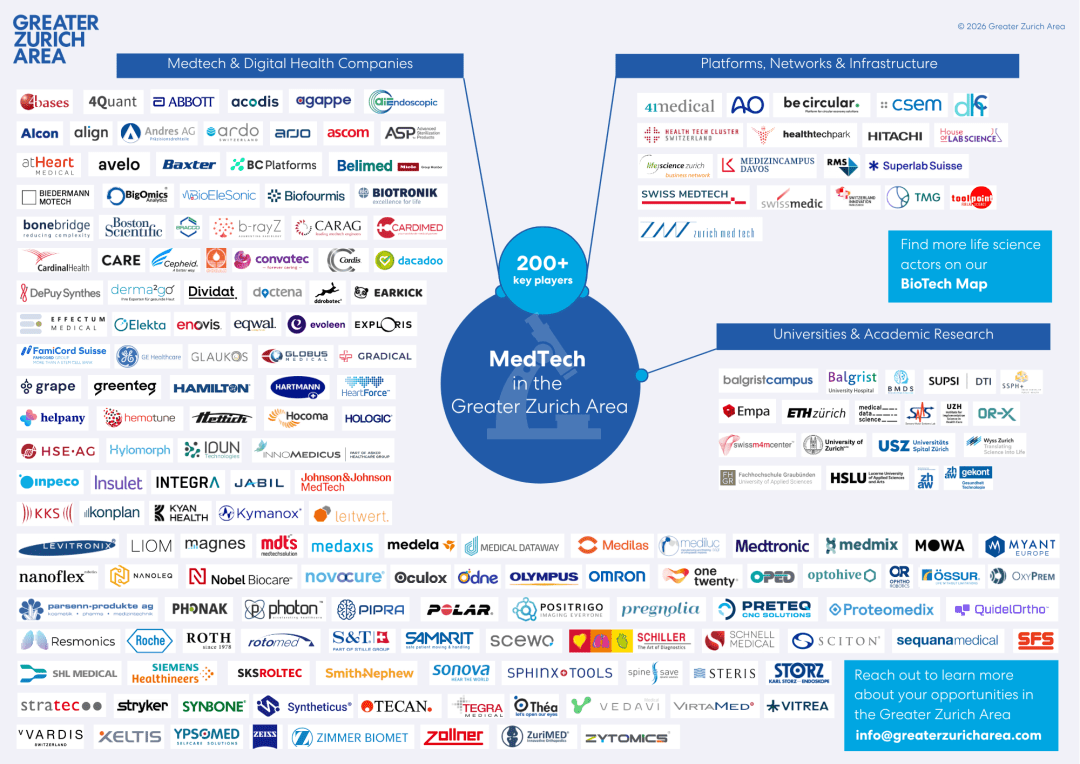
The Greater Zurich Area is one of Europe's leading locations for life sciences, bringing together world-class universities, internationally recognised research hospitals, global pharmaceutical companies, pioneering medtech innovators and a highly collaborative healthcare ecosystem. This unique concentration of expertise enables companies to develop, validate and commercialise the next generation of medical technologies.
From research to clinical impact
The greatest medical innovations improve patient care only when they are successfully translated into clinical practice. Greater Zurich's internationally recognised hospitals, research institutions and life sciences community provide an environment where companies can collaborate with clinicians, generate evidence and prepare new technologies for wider adoption across Europe.
What is the one thing about the Swiss ecosystem - talent, universities, hospitals, investors, regulatory environment - that excites you most? What types of Swiss hospitals or clinical partners would create the greatest value for Zeta at this stage?
The most valuable partners would be leading hospitals and clinical groups that combine high-acuity patient care with a genuine interest in research and innovation. For the surgical navigation platform, that means neurosurgery, neurocritical care, interventional neuroradiology, and centers that handle procedures such as EVD placement, shunt procedures, stereotactic biopsy, rhizotomy, and other minimally invasive cranial interventions.
For Zeta TMS Navigation, it means psychiatric and neurostimulation centers interested in more accurate and reproducible targeting for TMS and related brain stimulation workflows. The ideal partner is a team that can evaluate accuracy, safety, usability, and workflow impact - and that wants to help shape how image-guided procedures are delivered outside the traditional boundaries of the operating room.
Are you willing to share Zeta Surgical's plans for the coming 12-24 months?
Our near-term focus is execution. In the United States, we are continuing to commercialize our FDA-cleared navigation platforms and expand clinical adoption across neurosurgery and TMS. That includes generating more evidence, supporting early hospital deployments, and continuing to build the product portfolio around procedures where accurate, fast, point-of-care navigation can make a meaningful difference.
Internationally, the next 12-24 months are about building the foundation for Zeta's next phase. In Greater Zurich, that means establishing the right engineering and R&D functions, recruiting the first core team members, building relationships with hospitals and academic collaborators, getting CE mark, and building other foundations for commercialization in Europe.
Facts & figures: Zeta Surgical
- Industry/sector: Medtech, Digital surgery, AI-powered surgical navigation
- Founding year: 2018
- Headquarters
- Current: Boston, Massachusetts, United States,
- Future: Boston as U.S. headquarters and commercial/regulatory base, with Greater Zurich Area as a planned European engineering, R&D, and European commercial hub
- Employees (Global): 11, with planned phased buildout of a core Swiss engineering and R&D team over the next three years.
- Functions in Greater Zurich: R&D; product engineering; clinical research collaborations; European commercialization; IP/licensing support.
- Clinical partners: Mass General Brigham; Big Ten Neurosurgery Consortium; HOPE Therapeutics; Singapore General Hospital.

Thinking about expanding your business?
Thinking about expanding your business?
Let us connect you with the right person to learn more about how the Greater Zurich Area Ltd can support your business needs.
Our services are free of charge and include:
- Introductions to key contacts in industry, academia and government
- Advice on regulatory framework, taxes, labor market and setting up a company
- Custom-made fact-finding visits including office and co-working space